Lovart Review (2026): Concept vs Execution
Legacy methodology: This article uses VibeDex's retired April 2026 creative-platform scoring (0–5 composite across a 14-platform set), since superseded by the v2 capability + trust-verdict framework. Scores, pricing, and platform names (including the pre-rebrand “Freepik,” now Magnific) reflect that snapshot and may be out of date. See the current Creative AI Platform guides
TL;DR
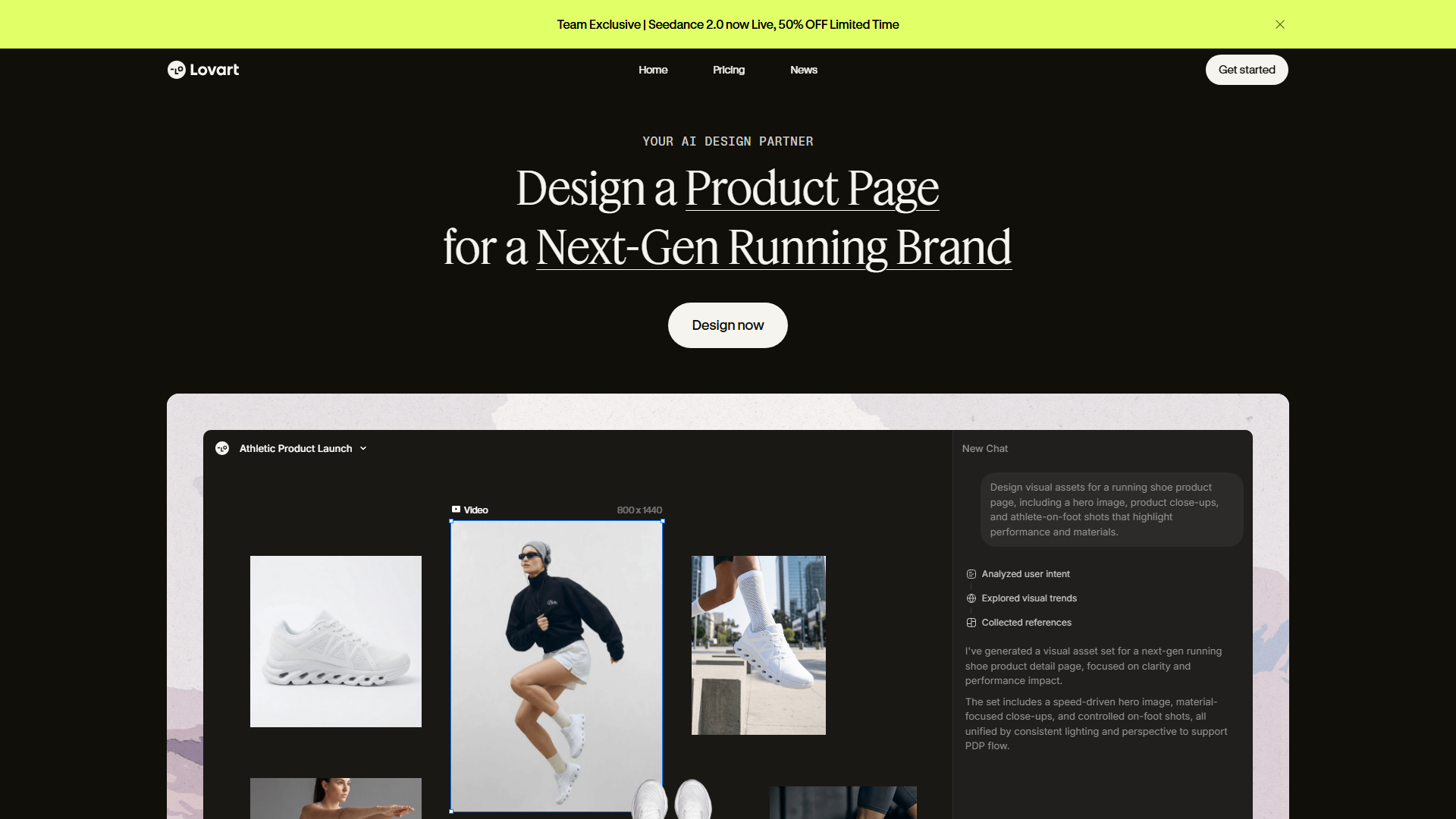
Lovart scores 2.80/5 and ranks #11 of 14 platforms as of April 2026. Voice Mode is unique in the market — no other platform lets you describe designs verbally to an AI agent. Real-time collaboration: 4/5. But execution undermines the vision. Lovart limitation: 2-3 minute generation time — slowest of all 14 platforms tested (vs 5-10 seconds on most competitors). Google Play rating: 2.1/5 across 141 reviews[1] vs Product Hunt 4.9[2]. Users report account lockouts with unresponsive support[5] and non-refundable charges[9]. The reported $30M Series A (January 2026, per sponsored content)[4] and 70+ country presence suggest ambition, but the product needs fundamental speed and reliability improvements before it can compete with Flora (3.85) or Fotor (3.85).
Lovart is not one of the ten platforms in our Creative AI Platform landscape, our depth benchmark of ten platforms across five creative jobs. This review uses our capability and trust study instead, so its verdicts are not comparable with the landscape ratings.
Recommended Benchmarks
- Best Creative AI Platform 2026: Safe Picks by Buyer TypeCanva is the safest default Creative AI Platform for most buyers. CapCut broader but trust-capped, Fotor wins e-commerce, Magnific the clean-trust paid pick.
- Lovart vs Flora (2026): Agent ComparisonLovart vs Flora: Flora (3.85) beats Lovart (2.80) by over a full point. Both use AI agents, but Flora generates about 10x faster with far better onboarding.
- What AI Platforms Really Charge (2026 Tested)We priced identical Nano Banana Pro and Seedance 2.0 output across 6 platforms against Google and ByteDance list rates. Same model, same settings, 2.7x apart.
- Figma Weave vs Wireflow (2026): Original vs ForkFigma Weave (3.25) beats its fork Wireflow (2.25) on the Figma acquisition, enterprise indemnity and real support, while Wireflow suffers connection failures.
Full Score Breakdown: 20 Dimensions
Lovart has a bottom-heavy profile as of April 2026: only three dimensions at 4/5 (onboarding, output quality, collaboration) and seven dimensions at 2/5 or below (speed, model selection, export, output management, mobile, templates, customization). The platform has clear vision but struggles with the basics — speed, reliability, and content management.
| Dimension | Score | Notes |
|---|---|---|
| Onboarding | 4/5 | Guided agent-based setup, clear first steps |
| Prompt Tools | 3/5 | Chat-based prompting with agent interpretation |
| Model Selection | 2/5 | Limited model options behind the agent |
| Speed | 2/5 | 2-3 minutes per generation — unacceptably slow |
| Output Quality | 4/5 | Good quality when it finally renders |
| Iteration | 3/5 | Agent-mediated iteration, slower but contextual |
| Editing Tools | 3/5 | Canvas editor with basic tools |
| Cross-Modal | 3/5 | Image + some design layout capabilities |
| Export | 2/5 | Limited export formats and resolution options |
| Output Management | 2/5 | Basic project organization, no search |
| Mobile | 2/5 | App exists but rated 2.1/5 on Google Play |
| Templates | 2/5 | Minimal template library |
| API Access | 3/5 | API available but limited documentation |
| Customization | 2/5 | No custom model training |
| Collaboration | 4/5 | Real-time collaboration — a genuine strength |
| Pricing Flexibility | 3/5 | Free tier + paid, but non-refundable charges |
| Content Rights | 4/5 | Commercial rights included |
| Safety | 2/5 | Basic content filters |
| Trust | 2/5 | Account lockouts, unresponsive support, non-refundable charges |
| UX Polish | 4/5 | The interface itself is well-designed |
Composite score: 2.80/5 (average of all 20 dimensions). Ranked #11 of 14 platforms.
Strengths and Limitations
Lovart
Strengths
- +Voice Mode is genuinely unique — no other platform lets you describe designs verbally to an AI agent
- +Real-time collaboration (4/5) with canvas+chat interface designed for team design workflows
- +Commercial rights included (4/5) on generated content, clear licensing terms
- +The AI agent concept — chat-based design iteration — points toward a compelling future for creative tools
Limitations
- −Generation takes 2-3 minutes — 10-30x slower than competitors like OpenArt (5-10s) or WaveSpeed (<2s)
- −Google Play rating of 2.1/5 across 141 reviews — users report crashes, slow performance, and lost work
- −Account lockouts with unresponsive support and non-refundable charges create genuine financial risk
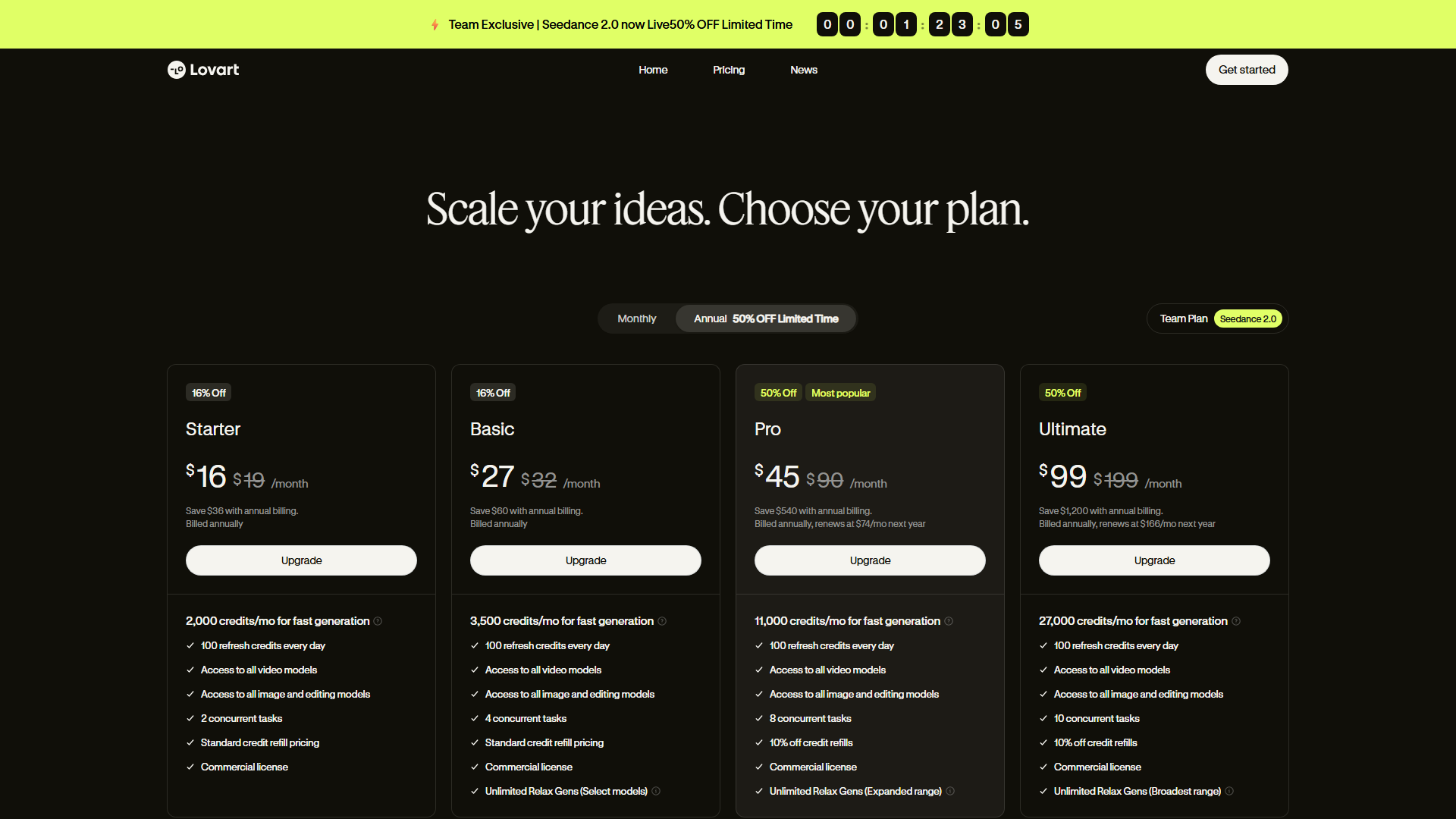
- −Free tier gives only 30 credits (~2.5 generations) — barely enough to evaluate the platform
The Agent Concept: Vision vs Reality
Lovart's canvas+chat interface lets you describe designs conversationally, and the AI agent interprets intent, generates options, and iterates on feedback. Under the hood, Lovart uses a multi-agent MCoT (Mind Chain of Thought) architecture to decompose complex design requests into sub-tasks[4]. Voice Mode extends this further — you can verbally direct a design agent, a capability no other platform in our benchmark offers as of April 2026.
Lovart limitation: the 2-3 minute generation time destroys conversational flow entirely. Creative dialogue requires rapid back-and-forth; when each exchange takes minutes instead of seconds, the “collaboration” feels more like waiting for a contractor than brainstorming with a partner. Flora delivers similar agent-like features at 10x the speed.
A reported $30M Series A and 800K beta users across 70+ countries (according to the company)[4] (~907K monthly website visitors) prove the concept resonates. But the product needs to be 10x faster to deliver on the promise. At current speeds, the agent paradigm works in theory and fails in practice.
Trust Warning
Lovart scores 2/5 on trust — the second-lowest in our 14-platform benchmark as of April 2026. The review gap is telling: Google Play 2.1 stars (141 reviews)[1] vs Product Hunt 4.9[2] — a massive casual-user vs power-user sentiment divide. Lovart also issued a public apology in March 2026 for GPU capacity outages that left paying users unable to generate[7]. Three documented, recurring issues:
- Account lockouts: Multiple users report being locked out with no prior warning and no ability to access generated content.
- Unresponsive support: When lockouts occur, the support team is reported as slow or non-responsive — no alternative recourse channel exists.
- Non-refundable charges: Paid credits are non-refundable[9], meaning locked-out users lose both content and money. Free credits: only 30 (~2.5 generations)[8].
Lovart limitation: do not store critical work exclusively on this platform. Consider the non-refundable policy before purchasing large credit packs. For comparison, Weavy (5/5 trust) offers enterprise indemnity and never trains on user data.
Who Should (and Shouldn't) Use Lovart
Consider Lovart if you:
- Are specifically interested in the AI design agent paradigm and Voice Mode
- Need real-time collaboration on AI-generated designs
- Are willing to tolerate 2-3 minute generation times for a unique workflow
- Want to evaluate an early-stage platform with an innovative direction
Skip Lovart if you:
- Need fast generation — 2-3 minutes per image is a dealbreaker for most workflows
- Cannot tolerate the risk of account lockouts and lost content
- Want a proven, stable platform — the 2.1/5 Google Play rating speaks volumes
- Need a generous free tier to evaluate — 30 credits gives you roughly 2.5 images
- Prefer any general-purpose platform — Flora (3.85) offers agent-like features at 10x the speed
Sources & References
All external sources were verified as of April 2026. Ratings and metrics reflect the most recent data available at time of review.
- Google Play - Lovart AI Design Agent (141 reviews, 2.1 stars)(play.google.com)
- Product Hunt - Lovart AI (12 reviews, 4.9 stars)(producthunt.com)
- G2 - Lovart AI Seller Profile(g2.com)
- TechCrunch - Lovart AI Design Agent (Sponsored Feature)(techcrunch.com)
- Skywork AI - Lovart AI Review 2025(skywork.ai)
- Apple App Store - Lovart AI Design Agent(apps.apple.com)
- Lovart - Official Apology for GPU Outages (March 2026)(lovart.ai)
- Lovart - Subscription FAQ & Credit Policy(lovart.ai)
- Lovart - Refund Policy(lovart.pro)
- Lovart - Privacy Policy (July 2025)(lovart.ai)
- Pippit AI - Lovart AI Review(pippit.ai)
- Lovart - Video Generator (Sora 2, Veo 3, Kling 2.6)(lovart.ai)
Related VibeDex Benchmarks
Best AI Product Photography Tools (2026)
Best AI product photography tools: 11 Creative AI Platforms checked, 4 with named e-commerce workflows: Photoroom, Krea, Fotor and Magnific (formerly Freepik).
RoundupsBest AI Tools for Static Social Ad Creative (2026)
Best AI tools for static social ads: 11 Creative AI Platforms checked. Canva, Recraft, Adobe Express, Leonardo, Picsart, Photoroom and Fotor are specialized.
RoundupsBest Free AI Background Remover (2026)
Best free AI background remover: 12 Creative AI Platforms ranked by what the free tier delivers. Recraft and Picsart lead on no-signup; Photoroom on commercial.
Methodology: Rankings and scores in this article align to VibeDex's current Sonnet 4.6 blind benchmark: 50 prompts, 3 passes, and 150 judgments per model across visual fidelity, physics, subject integrity, and instruction adherence. See our full methodology
FAQ
Is Lovart worth trying in 2026?
The free tier gives you 30 credits, which translates to roughly 2.5 generations — barely enough to evaluate the platform. If the AI design agent concept interests you, it is worth a quick test, but set expectations low. The 2-3 minute generation times and 2.1/5 Google Play rating reflect real, persistent issues that a reported $30M in funding has not yet resolved.
What is Lovart Voice Mode?
Voice Mode lets you describe your design intent verbally, and Lovart's AI agent interprets your speech to generate and iterate on designs. It is a genuinely unique feature — no other platform in our benchmark offers anything equivalent. The concept is innovative, but the execution is limited by the same slow generation times that affect the rest of the platform.
Why are there complaints about Lovart account lockouts?
Multiple users report being locked out of their Lovart accounts with no warning and no responsive support channel. Combined with non-refundable charges on the platform, this creates a real financial risk. The Trust score of 2/5 reflects these documented issues.
See how every model stacks up
The VibeDex leaderboard ranks 18 image models on a 50-prompt blind benchmark, judged by Claude Sonnet 4.6 across visual fidelity, physics, subject integrity, and instruction adherence.
See the leaderboard →